Guide · Complete Guide
Prenups in the Philippines for Foreign Nationals
A practical guide for foreign nationals marrying Filipino citizens who need to understand Philippine prenuptial agreements, property regimes, overseas assets, and timing before the wedding.


Atty. Gerard Benedict G. Valerio
from valeriolaw.ph
Consult with legal counsel before relying on this article for your specific facts.
The Quick Answer
A foreign national may enter into a Philippine prenuptial agreement with a Filipino spouse if the agreement is made before marriage and follows the rules for marriage settlements. The usual purpose is to choose a property regime, often complete separation of property, instead of relying on the default absolute community regime. It does not guarantee treatment of assets in another country and should be reviewed by Philippine counsel before signing.
Key Takeaways
- 01A Philippine prenup is a marriage settlement that fixes the spouses' property relations before marriage.
- 02If there is no valid prenup, the default property regime under the Family Code is generally absolute community of property for marriages governed by the Family Code.
- 03Complete separation of property is commonly considered by Filipino-foreigner couples, but it must be properly drafted and executed.
- 04A Philippine prenup does not automatically protect foreign assets or control how a foreign court, bank, registry, or tax authority will treat property abroad.
- 05It is best to consult Philippine counsel before signing, especially when inheritance, future waivers, support, children, businesses, or foreign assets are involved.
Many Filipino-foreigner couples ask whether a prenuptial agreement is necessary before getting married in the Philippines or before registering a marriage that will have Philippine legal consequences. The concern is usually practical: one or both parties may already own property, operate a business, support family members, or hold assets in different countries.
Under Philippine law, a prenup is not simply a private promise between partners. It is a legal agreement that may determine the spouses' property regime during marriage. This matters because, without a valid marriage settlement, the law may supply the default rules.
For foreign nationals, the most important point is also the most commonly misunderstood: a prenup can help clarify property relations, but it does not guarantee how foreign assets will be treated outside the Philippines.
What is a prenup under Philippine law?
A prenuptial agreement is commonly referred to under the Family Code as a marriage settlement. It is an agreement made before marriage where future spouses choose the property rules that will govern them during the marriage, within the limits allowed by law.
For Filipino-foreigner couples, the prenup is often used to address whether property will be shared, kept separate, or governed by another permitted arrangement. It may also identify existing assets, business interests, debts, and expectations for property acquired after marriage.
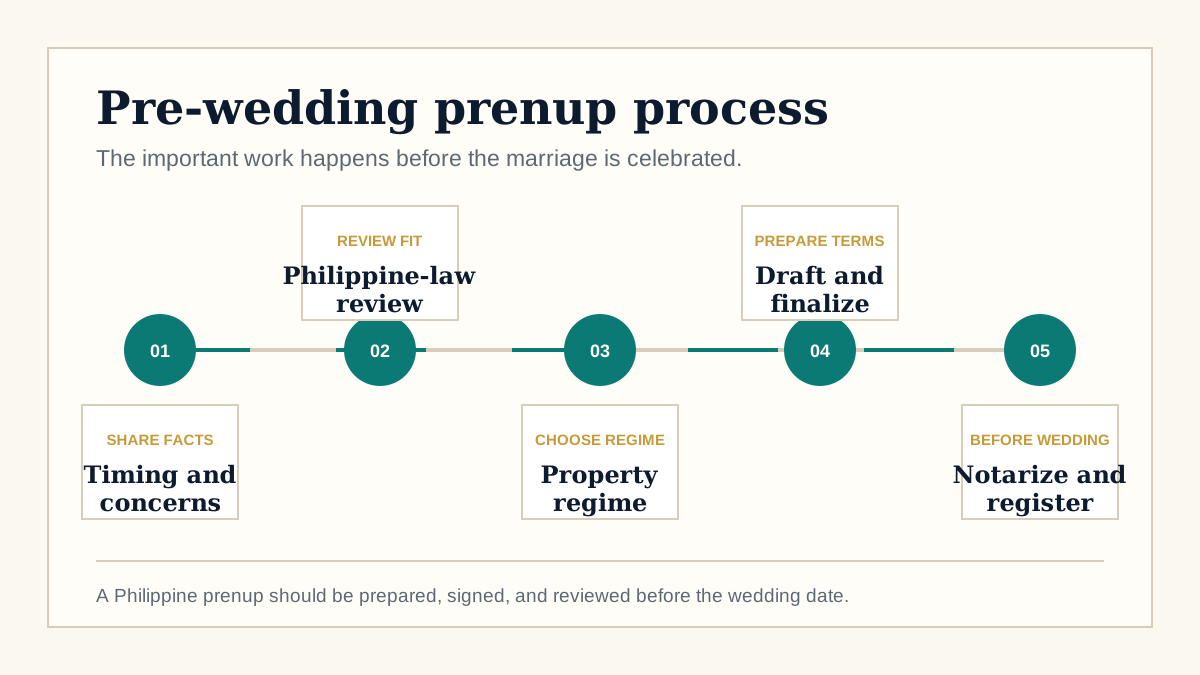
The key issue is timing. A Philippine marriage settlement must be executed before the celebration of marriage. Once the marriage takes place, the spouses cannot treat the prenup as an afterthought and expect it to have the same legal effect.
- It should be prepared before marriage.
- It should be in writing and signed by the parties.
- It should be drafted within the limits of Philippine law.
- Registration may matter for effect against third persons.
- It should be reviewed before signing, especially where businesses, prior obligations, or foreign assets are involved.
What happens if there is no prenup?
If the marriage is governed by the Family Code and the parties do not execute a valid marriage settlement, the default property regime is generally absolute community of property. In simple terms, the law may treat many properties of the spouses as part of a common property mass, subject to exclusions and specific rules.
This default regime may not match what the couple intended. One spouse may believe that property bought with separate funds will remain separate. Another may assume that assets abroad are automatically excluded. Those assumptions can create disputes later.
For marriages before the effectivity of the Family Code, different default rules may apply. Because the date and circumstances of marriage can affect the analysis, older marriages should be reviewed separately.
- Do not assume that personal funds always remain legally separate after marriage.
- Do not assume that a foreign spouse is outside Philippine family-property law.
- Do not assume that property abroad is automatically protected by a Philippine document.
- Do not rely on informal understandings when a formal marriage settlement is needed.
Why is complete separation of property often considered?
The Family Code allows spouses to agree on complete separation of property. Under this regime, each spouse may generally own, administer, enjoy, and dispose of his or her own separate property, subject to the terms of the agreement and applicable law.
This arrangement is often attractive to Filipino-foreigner couples because it can reduce uncertainty. It may help distinguish assets owned before the marriage, income earned during the marriage, business interests, personal investments, and debts.
However, complete separation of property is not a magic clause. It must be properly drafted, specific enough to work in practice, and careful not to waive rights or impose terms Philippine law does not allow.
- Identify existing assets and liabilities clearly.
- State how future income, purchases, investments, and debts will be treated.
- Address business ownership and management carefully.
- Avoid provisions that try to defeat mandatory law or public policy.
- Seek separate foreign advice if assets are located outside the Philippines.
Will a Philippine prenup protect foreign assets abroad?
A Philippine prenup may be useful evidence of the spouses' intentions, but it does not automatically control assets located in another country. Foreign courts, registries, banks, pension administrators, tax authorities, and succession rules may apply their own law.
This matters for foreign nationals who own real estate, retirement accounts, companies, brokerage accounts, or inheritance expectancies abroad. A Philippine document may not be enough to determine how those assets are divided, administered, transferred, or taxed.
The safer approach is to treat the Philippine prenup as one part of a broader cross-border plan. This article is written from a Philippine-law perspective. Its author is not giving foreign-law advice and is not licensed to advise on every jurisdiction where an asset, account, court, or registry may be located.
- Do not assume a Philippine prenup binds a foreign court.
- Do not assume foreign real estate is protected by Philippine wording.
- Do not make blanket claims that all foreign assets are excluded.
- Do not treat a prenup as a substitute for tax or estate planning.
- Get local advice in each country where important assets are located.
Questions couples often ask
Can a foreigner get a prenup in the Philippines?
Yes. A foreign national may sign a prenuptial agreement with a Filipino spouse, provided the agreement complies with Philippine legal requirements and is executed before marriage. Nationality does not prevent signing, but it may affect what the agreement can validly cover.
Does a Philippine prenup automatically work abroad?
No. A Philippine prenup may help show intention, but foreign assets may be governed by the law of the country where the asset is located, where the account is maintained, or where a court has jurisdiction. If foreign assets are part of the plan, contact the Valerio Law team so counsel can identify what the Philippine agreement can address and where separate foreign advice may still be needed.
Is separation of property always the right regime?
Not always. Complete separation of property is commonly considered by Filipino-foreigner couples, but the right property regime depends on the couple's assets, debts, businesses, countries involved, and long-term plans.
Can we sign the prenup after the wedding?
A Philippine marriage settlement must be made before the marriage to serve as a prenup fixing the property regime. Post-marriage arrangements raise different legal issues and should not be assumed to have the same effect.
Legal Review
General information only
This guide is for general information only. A Philippine prenup should be reviewed against the couple's wedding date, property goals, signing, notarization, registration, and any cross-border concerns. Use the Inquire button to share your situation with the team at Valerio Law for free so they can review fit before a proposal.
Source basis
Legal sources referenced
These sources are used to ground the article's discussion of Philippine marriage settlements, property regimes, and related legal limits. They are provided for context and do not replace case-specific legal review.
Related blogs

No Prenup in the Philippines? What Happens Without One
If you marry in the Philippines without a prenup, the law supplies the property regime for you. For many Family Code marriages, that default is absolute community of property.
Read guide
Separation of Property in the Philippines for Foreigners Marrying Filipinos
A prenuptial agreement choosing complete separation of property can help clarify what each spouse owns and manages during marriage, but it must be prepared before the wedding.
Read guideWant a prenup proposal?
Share the marriage timing and basic property-regime questions for free. The team reviews fit before sending next steps or a proposal.
Get Your Prenup Proposal